Built for compliance
from day one.
Innvois keeps records, tax context, and compliance evidence structured as the business runs, so filing is not a last-minute rebuild.
Most African SMEs fail tax season
not because they didn't pay, but because they couldn't prove it.
Invoices in WhatsApp. Receipts in a drawer. VAT records in a spreadsheet nobody updated. When FIRS comes or an audit happens, the records simply aren't there and the cost is enormous.
Innvois fixes this at the infrastructure level. Compliance isn't a feature you turn on. It's built into how the system works from the first transaction.
Compliance should not start at the end.
Most businesses think about tax too late, when records are incomplete, data is scattered, and deadlines are already close.
Innvois structures financial data as it is created, so tax position, reporting, and audit history are already there when needed.
What Innvois handles for you.
Innvois supports financial accuracy, traceability, and compliance workflows in the same system your business already uses.
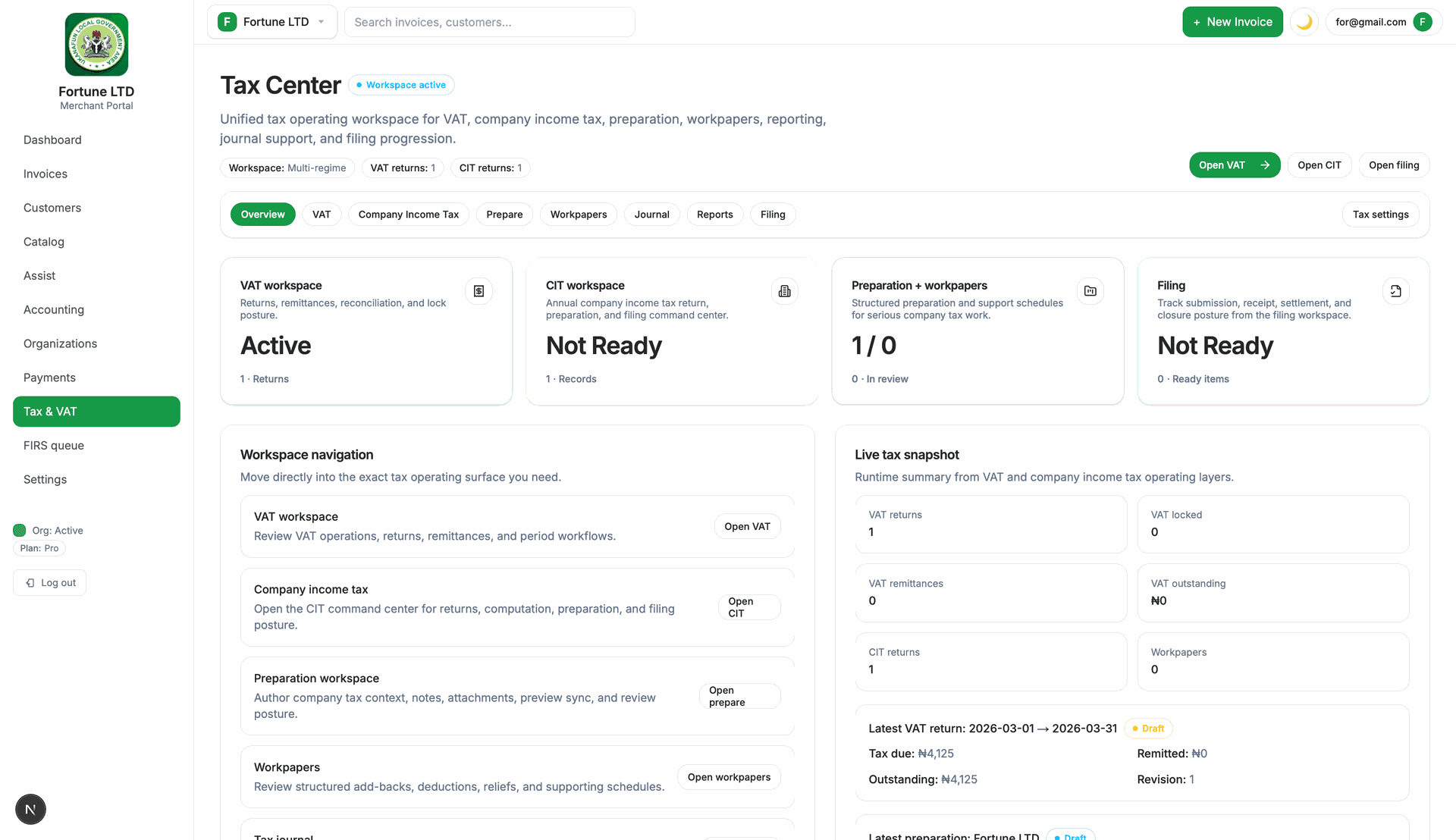
VAT-ready records
Every transaction captures output and input VAT context automatically, structured and ready for reporting.
CIT workspace
Preparation workflows for company income tax workpapers, adjustments, and computation-ready data.
Structured financial records
Sales, payments, and expenses are stored in a consistent, traceable format, not scattered across tools.
FIRS-aligned structure
Records are modeled to match real regulatory expectations not retrofitted during filing.
Audit trails
Every financial action is logged with timestamp, actor, and context creating a verifiable history.
Export & reporting
Generate summaries and structured exports for accountants, audits, and compliance workflows.
VAT should be built into operations, not reconstructed later.
Transaction activity feeds VAT-ready records as the business runs, giving you cleaner reporting and less quarter-end stress.
- VAT context tracked at transaction level
- Output and input tax ready for structured summaries
- Export-friendly reporting for accountant workflows
- Built to reduce quarter-end scramble
Quarter
Q2 2026
Output VAT
₦156,400
Input VAT
₦42,100
Net VAT
₦114,300
Preparation
Annual return workspace
Workpapers
Add-backs, deductions, schedules
Adjustments
Mapped for tax review
Computation
Computation support layer
Filing bundle
Export and submission support
Company income tax needs more than a spreadsheet.
Innvois supports a structured CIT workflow from preparation and workpapers to computation support and filing-ready outputs.
This is one of the clearest ways Innvois separates itself from lightweight billing tools: it is built for downstream financial seriousness.
- Preparation workspace for company income tax
- Workpapers, adjustments, and computation support
- Structured records feeding year-end tax workflows
- Designed for filing-readiness, not spreadsheet patchwork
Why this matters
Most African SMEs pay more tax than they should — or face penalties they shouldn't — because their year-end computation is rushed, undocumented, and unverifiable. The Innvois CIT workspace turns tax preparation from a panic event into a structured, year-round process. When filing time comes, the work is already done.
Strong records are not just about storage.
They are about traceability, accountability, and being able to show what happened clearly when it matters.
What Innvois records
Why this matters
Built for the moment someone asks you to prove it.
Audits, disputes, regulatory reviews — when they happen, your records are either ready or they're not. Innvois makes sure they're always ready.
Audit trails by default
Every invoice created, payment received, expense logged, and record changed is tracked — with timestamp, actor, and action. Immutable.
Period locking
Filed periods are locked and protected from edits. Your historical records stay accurate for dispute resolution and regulatory review.
Filing lifecycle management
Track the full status of every tax filing — draft, prepared, reviewed, submitted, confirmed. Nothing gets lost between steps.
Evidence system
Store receipts, bank statements, correspondence, and regulatory documents attached to the records they relate to.
FIRS alignment
Records are structured to match Nigerian tax authority requirements — not adapted after the fact, but built that way from day one.
NDPA-aligned data practices
Personal and financial data handled under Nigerian Data Protection Act principles. Privacy controls built into the infrastructure.
How compliance builds inside the system.
Compliance builds from the same business activity already happening inside the platform.
Create the transaction
A sale, invoice, payment, or expense enters the system as a structured record.
Capture tax context
Relevant VAT and financial metadata are attached as business activity happens.
Update books and summaries
Records feed reporting, visibility, and downstream compliance layers automatically.
Generate audit-ready outputs
Exports, summaries, and evidence-friendly records are available when needed.
Support filing workflows
VAT and CIT processes can build from existing records instead of manual reconstruction.
The benefit:
Better operational records lead to cleaner tax position, clearer reporting, and less deadline panic.
TLS in transit
Secure transport across user and system traffic
Protected storage
Financial data handled with structured storage practices
PCI via payment gateway
Sensitive payment handling delegated to gateway infrastructure
Auditability
Important actions logged for accountability and review
Stop dreading tax season. Start building records that defend themselves.
Free to start. Compliance infrastructure built in from your first transaction.